The public setlist shows music identified from the Pub’s room audio and a searchable history of earlier tracks.
 Example with a fictional track.
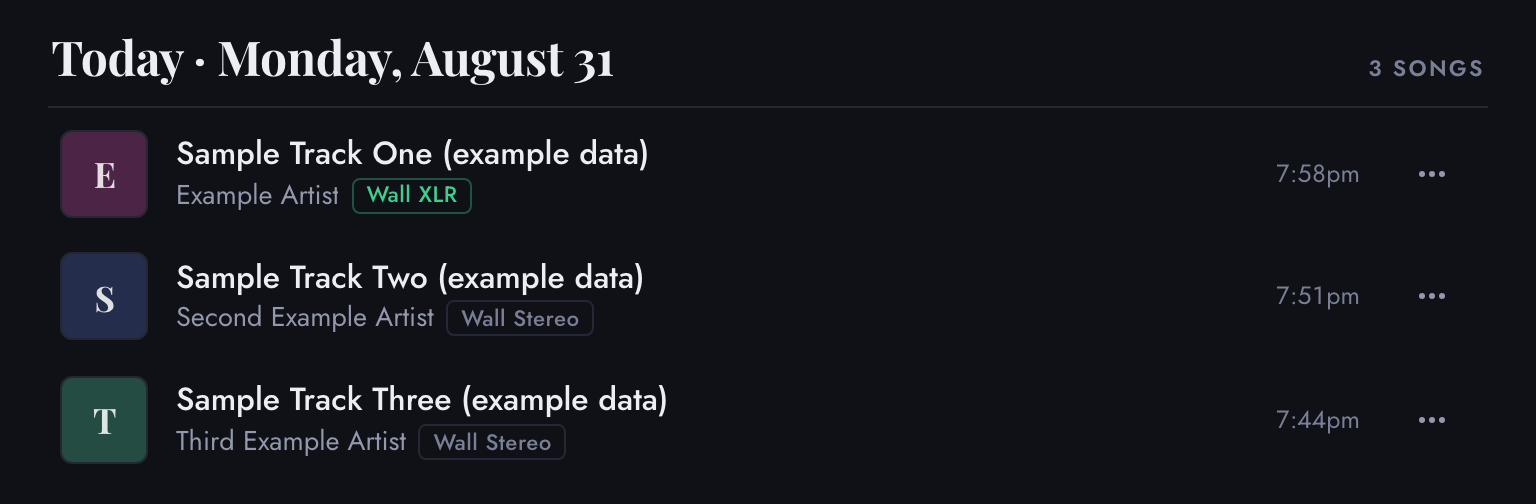 Example history with fictional tracks.
What the live card means
| What you see | Meaning |
|---|---|
| Now playing | A recent track was identified; title, artist, available artwork, and a Save action are shown |
| Quiet right now | On the Today view, the identification service is online but has not identified current music |
| An offline notice | Live identification is unavailable, so the setlist is not updating live; stored history can still be browsed |
Identification is best effort. A missing track can mean silence, a short clip, live performance, a catalog miss, or a temporary connection problem.
Browse and share
Visitors can move through recent time periods, search the loaded history by title or artist, and open a track for links to common music services. Those links perform a search; they are not a guarantee that every service has the exact recording.
Additional public views summarize the same history, such as popular tracks, a nightly recap, or longer-period retrospectives. A view may be unavailable until enough source data exists. Some summaries are written automatically from the same history and can be inaccurate.
How updates arrive
flowchart LR
  ROOM["Room audio"] --> IDENTIFY["Music identification"]
  IDENTIFY --> SERVICE["Validated track metadata"]
  SERVICE --> LIVE["Live setlist update"]
  SERVICE --> HISTORY["Searchable history and summaries"]
In words: Music identification turns room audio into validated track metadata. Pub uses that metadata for both the live setlist and searchable history and summaries.
The live page receives small state updates while it is open. Historical browsing uses bounded pages so a visitor does not need to download the complete archive at once. If the live connection drops, the page keeps stored history available and reconnects automatically. When live identification is offline, the page shows a notice that the setlist is not updating live.
Data and privacy
The setlist stores recognized track metadata, timestamps, and limited source context used to describe what was heard in the public room. It does not attach a resident, patron, listener, or operator identity to a track.
Music heard during a confirmed film screening may be grouped with that movie rather than counted as ordinary bar music.
Technical boundary
Public consumers can read current state, paged history, and selected summaries. Writing recognition results and controlling venue playback require protected access.